

A featured contribution from Leadership Perspectives: a curated forum reserved for leaders nominated by our subscribers and vetted by the Construction Tech Review Advisory Board.

Fender Musical Instruments Corporation
The Cloud, IoT, and Machine Learning-Leading to the Path of Opportunities
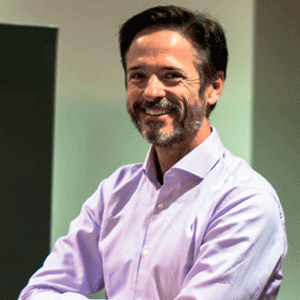
Michael Spandau
Cloud computing, IoT, and machine learning are going to fundamentally transform the way we provide services to all corporations. Cloud computing has enabled us to perform advanced capabilities that we wouldn’t have been able to deliver traditionally. Meanwhile, IoT gives us the ability to track certain events throughout the supply chain and logistics, and I believe that it will fundamentally change how we carry out our supply chain. Finally, machine learning offers us the abilities that we don’t have today— from porting to predictive capabilities. So, we are now deploying IoT devices throughout the shop floor to track the position, temperature, and humidity.
We have a lot of components and parts within the facility, and we use IoT to notify when certain parts are on the inventory, and the rest gets automatically triggered. The technology is also used to track the position of the semi-finished goods all over the facility. On the machine learning side, Fender has been using SAP for more than ten years. We have a significant amount of transactional data and what we’re planning to do is combine that transactional data with machine learning algorithms. This will help us to improve things such as keeping a track on delivery dates, product arrival at our customers’ place, product arrival from our suppliers to either our whole warehouse or to all the production facilities.
What are some of the challenges that you are witnessing today?
The challenge is that we are still at the beginning of the transformation, so the learning curve is significant. I think on the IoT side, we are able to make faster progress because a lot of these components are readily available and our partnership with AWS is helping us put that in place. However, when it comes to machine learning, I would say that we are still very much at the beginning stage but what we do realize is that cloud vendors like Amazon have opened the gates for other companies to provide cloud solutions. Now it’s up to us to embrace this technology and start utilizing it.
It’s a very competitive landscape as there are a lot of providers out there today. I made the decision to place a bet on AWS years ago, and we have been leveraging it for seven years now, and more than 50 percent of our production loads are on the AWS cloud. We are still associated with AWS because they provided and will continue to provide the functions and capabilities that we are looking for. So, our approach is, first: cloud and secondly: to ensure if the capabilities that AWS provides matches our requirements, and typically for us, AWS introduces us to these sophisticated functions. So, it’s a great partnership, and there are certain things that we do with Azure, such as E-Mail Exchange, Office 365, and so forth.
Moreover, for the company of the size of Fender, we cannot afford using multiple cloud providers as it’s just not practical. You have to pick your tool, speak with all your partners and then move forward with the same.
What are some of the common misconceptions in the IoT and machine learning space? How do you advise your peers accordingly?
Some of the misconceptions are probably related to security and vendor lock-in. Earlier, we had to go for long-term capital investments for using a certain service or product, which increased expenditures. The suppliers get into lock-in condition because they get hold of a long-term deal which assures a guaranteed profit and also the supplier can be in a better position than a customer as they have some of the smartest security experts’ working for them. But vendor lock-in can be avoided by using training materials that are freely available in the public domain and also trusting the knowledge that the workforce at an organization possesses.
The last thing I would say is “think big, start small, and be ready to take some risks, and continue to move forward.” Earlier, we would spend a lot of money to make a big investment to be able to move forward, but with today’s capabilities, with a minimal investment, you can tie a lot of different things and see if they move the ball forward. I think, in order to remain an attractive employer, you have to embrace these types of capabilities and technologies, not just because the business is expecting, but on the other side, your own IT employees would want to work on these types of capabilities too.
How would you see the evolution a few years from now with regards to transformations within the arena?
The way we deliver information will fundamentally change. I’m very intrigued by the “Alexas” of this world. I do believe that one day, we are going to move away from reporting as we do it today, and will interact directly with voice-based devices. So, instead of interacting with a portal, there will be business leaders, who will be communicating directly with voice-based devices, and these virtual assistants will be delivering the latest reports to them directly. Thirdly, providing information to the end-user is a trend that doesn’t exist today. It can only be done using a rich history of transactions on one side and machine learning algorithms on the other side, and a mechanism to deliver that information to the end user. These are the things that I see happening over the next few years.
What would be the piece of advice that you could impart to a CIO who looks to embark on a similar venture along the lines of your service?
We have providers out there that offer us tools and capabilities that are unheard of. My advice is to embrace that and to see how they apply them within their own organizations and work closely with these cloud providers because they offer an extensive portfolio of services. These are capabilities that are going to transform how we deliver services today, and we will only get there by embracing it.
